TL;DR
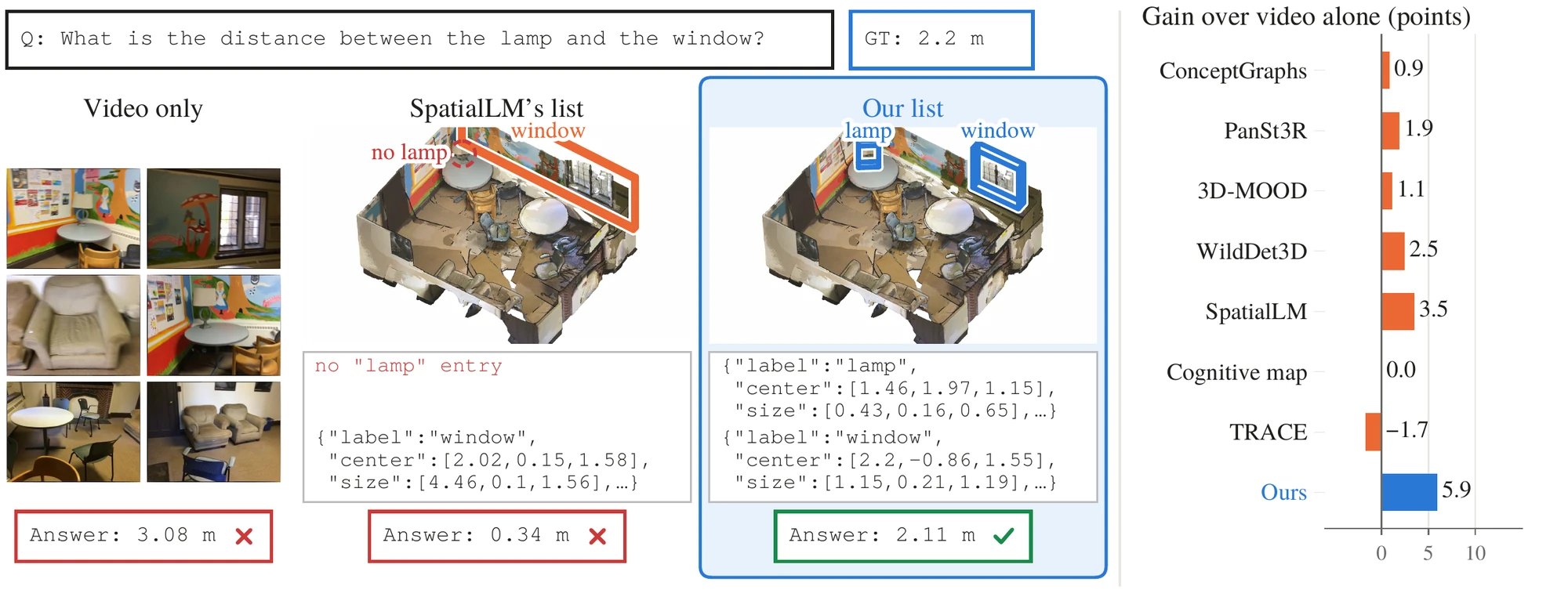
VLMs misjudge distances and sizes in video. Add the true list of objects and their 3D boxes, and Gemini 3.8 Flash jumps from 68.6% to 94.8% on a VSI-Bench sample. We build such a list from the video alone, and it makes every frontier VLM we tested better at spatial questions, with no fine-tuning. What matters most is that the list contains every object a question may ask about. Unrelated extra objects cost little.
Video
The list must contain the objects a question asks about
Abstract
Vision-language models (VLMs) still struggle to reason about space from video, misjudging distances, sizes and directions. Yet simply telling them where objects are can make a large difference. Given the video together with a text list of the objects in the scene and their ground-truth metric 3D boxes, Gemini 3.8 Flash answers correctly 94.8% of a sample of questions from the spatial benchmark VSI-Bench, compared with 68.6% from the video alone. This 26.2-point gain shows that the VLM can use 3D geometry to answer spatial questions much more accurately than it can infer that geometry from video. The challenge is to recover such a list from images. We therefore build an object-centric 3D representation with off-the-shelf reconstruction and segmentation models, once per scene and before any question is known. Given to the VLM alongside the original frames, it significantly improves accuracy on four spatial benchmarks, without fine-tuning any model. It also improves all five frontier VLMs we tested and provides larger gains than other 3D perception methods with the same VLM. In a controlled study, we introduce one type of error at a time into ground-truth lists to see which errors matter most to the VLM. Missing an object needed to answer a question costs the VLM two thirds of what the whole list adds. In contrast, adding unrelated objects barely affects its answers, although detection metrics count each of them as an error. Our results show that conventional detection metrics do not fully reflect what matters for VLM spatial reasoning. Covering every object a question may ask about matters more than avoiding unrelated detections.
Method
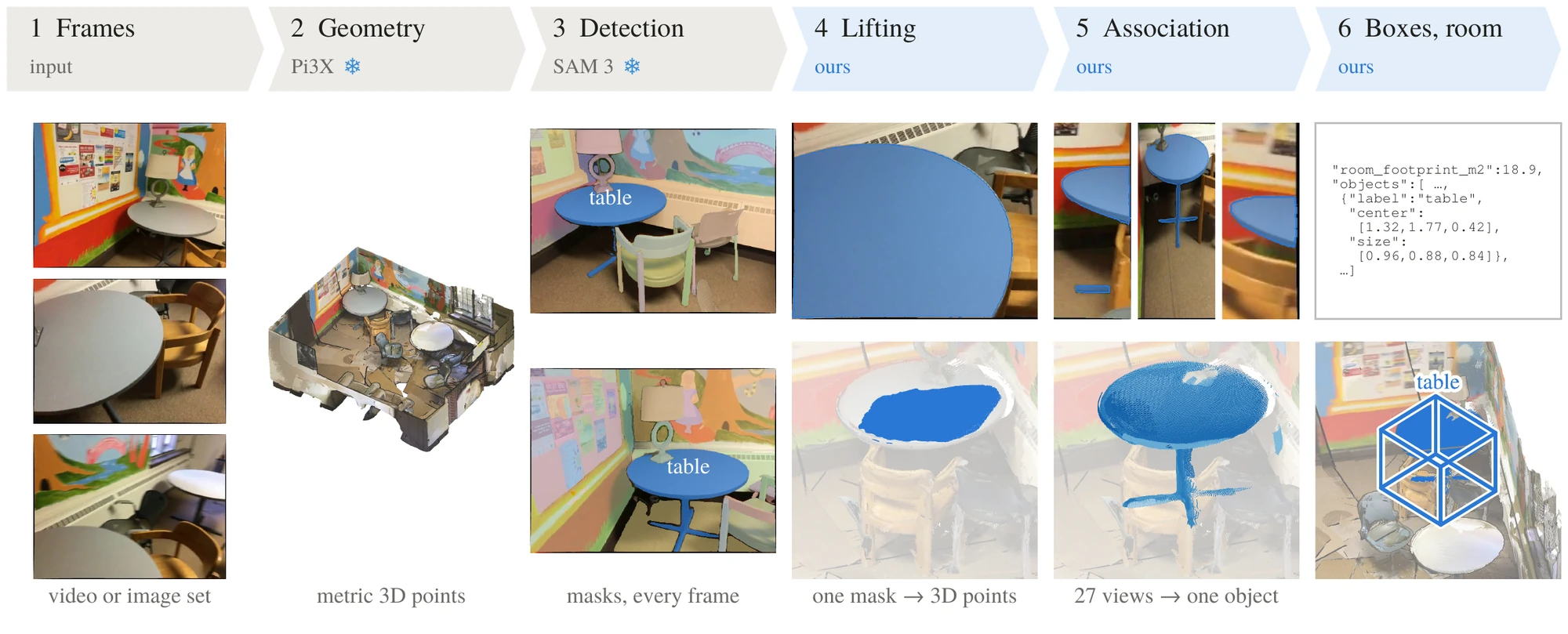
We build an object-centric 3D representation with off-the-shelf reconstruction and segmentation models, once per scene and before any question is known.
Results
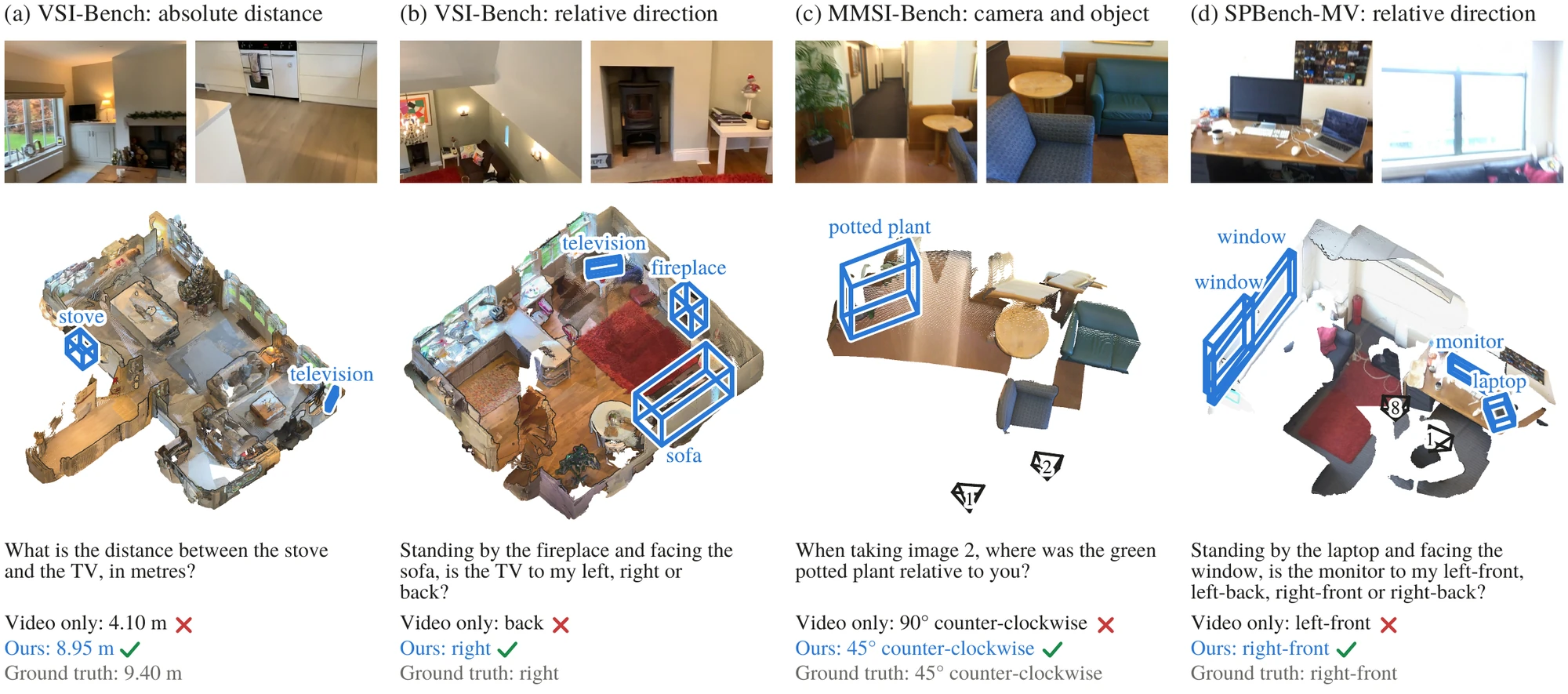
Given to the VLM alongside the original frames, the list significantly improves accuracy on four spatial benchmarks, without fine-tuning any model.
| Benchmark | Video only | + our list | Gain |
|---|---|---|---|
| VSI-Bench | 67.5 | 73.6 | 6.0 |
| VSI-Bench-Debiased | 65.3 | 71.6 | 6.3 |
| MMSI-Bench | 64.1 | 72.2 | 8.1 |
| SPBench-MV | 72.8 | 78.0 | 5.2 |
| MindCube-Tiny | 92.4 | 94.3 | 1.9° |
Results on five benchmarks. Accuracy (%) on the full test sets, Gemini 3.8 Flash with the same frames, without and with our list (Table 1 of the paper). °Not statistically significant.
What the list must get right
In a controlled study, we introduce one type of error at a time into ground-truth lists to see which errors matter most to the VLM. Missing an object needed to answer a question costs the VLM two thirds of what the whole list adds. In contrast, adding unrelated objects barely affects its answers, although detection metrics count each of them as an error.
BibTeX
@article{kocour2026structured,
title = {Structured 3D Scene Representations Improve VLM Spatial Reasoning},
author = {Kocour, Simona and Chen, Yutong and Sattler, Torsten and Prokudin, Sergey and Tang, Siyu},
journal = {arXiv preprint arXiv:XXXX.XXXXX},
year = {2026}
}Acknowledgments
This work was supported by the Czech Science Foundation (GACR) EXPRO (grant no. 23-07973X), the Ministry of Education, Youth and Sports of the Czech Republic through the e-INFRA CZ (ID:90254), the Grant Agency of the Czech Technical University in Prague, grant No. SGS26/098/OHK3/1T/13. Yutong Chen is funded by a Google PhD Fellowship.