arXiv preprint · 2026

DescOver: Descriptor Overlap Leaks the Image

Simona Kocour1,2, Torsten Sattler1, Zuzana Kukelova3, Marc Pollefeys4,5, Pablo Speciale4

1Czech Institute of Informatics, Robotics and Cybernetics, Czech Technical University in Prague
2Faculty of Electrical Engineering, Czech Technical University in Prague
3Visual Recognition Group, Faculty of Electrical Engineering, Czech Technical University in Prague
4ETH Zurich•5Microsoft Spatial AI Lab, Zurich

TL;DR

For upright descriptors, discarding keypoint positions does not hide the image. Neighboring descriptors describe overlapping image regions, so a set transformer can recover where each keypoint was, and an inversion model then reconstructs recognizable content. It works for five learned feature extractors, also on image domains unseen during training.
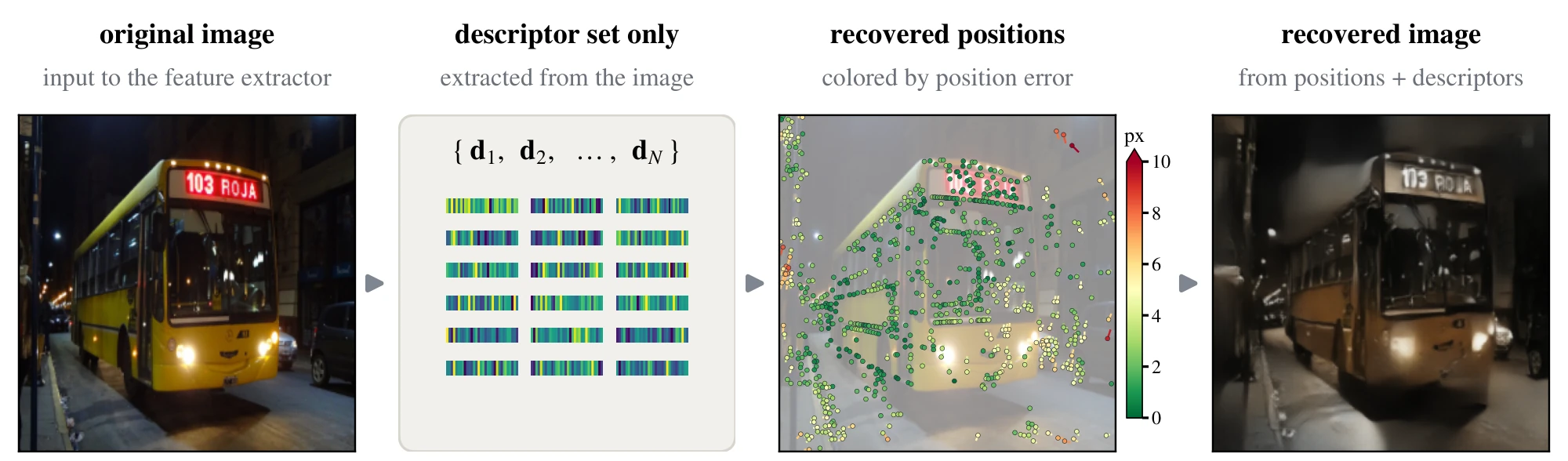
Original image; its descriptor set only; recovered positions colored by position error; recovered image from positions and descriptors.
Can an image be reconstructed from its descriptors alone? Recognizable image content can be reconstructed from local features, i.e., descriptors and their 2D keypoint positions. We show that 2D keypoints are not necessarily needed for the recovery process. From descriptors alone, our trained transformer predicts one 2D position per descriptor. An inversion model then reconstructs recognizable content from the descriptors at these predicted positions.

Abstract

Recognizable image content can be reconstructed from keypoint positions and descriptors of local features. This creates potential privacy risks when transmitting such data, e.g., in cloud-based visual localization. Obfuscation schemes aim to prevent these inversion attacks while retaining utility for tasks such as camera pose estimation. In this paper, we study the limiting case of geometric obfuscation, where all keypoint positions are discarded. Most modern learned descriptors are typically upright, i.e., computed without rotating image regions to per-keypoint orientations, and for these we show that keypoint positions can be recovered from the descriptors alone, enabling image inversion. Our key observation is that neighboring descriptors describe overlapping image regions in a common image frame, so their shared content reveals where their keypoints are relative to each other, not only which keypoints are neighbors. A set transformer trained on public images exploits this shared content to jointly predict all keypoint positions. We recover keypoint positions for five learned feature extractors, and the trained solvers also work on image domains unseen during training. Recovery also persists in several tested settings after training on subsampled or quantized descriptors. These results expose a limit of geometric obfuscation: for the descriptors studied, recognizable image content can be reconstructed even with all keypoint positions discarded. We will make our code and trained models publicly available.

Video

Key idea

Our key observation is that neighboring descriptors describe overlapping image regions in a common image frame, so their shared content reveals where their keypoints are relative to each other, not only which keypoints are neighbors.
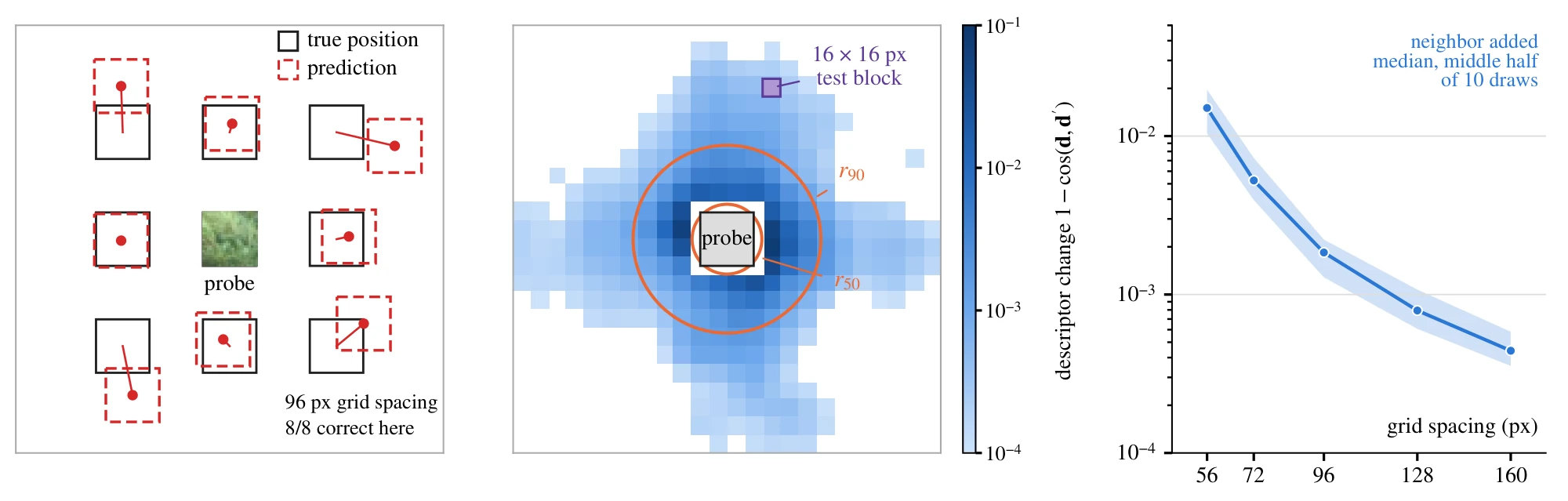
Neighbor photographs placed by the solver; map of descriptor change around a probe photograph; change against neighbor spacing.
ALIKED descriptor influence and position recovery. A probe photograph stays fixed on a white background. Left: one neighbor photograph is added per trial; the solver uses only descriptors from both photographs. True (solid) and predicted (dashed) positions have the correct direction in all eight trials shown. Middle: descriptor change when a 16×16 px block is added at each location, averaged over 15 probe keypoints. r50 and r90 (circles) are median radii enclosing 50% and 90% of change in individual keypoint maps. Right: change in the probe's descriptors versus neighbor grid spacing.

Method

A set transformer trained on public images exploits this shared content to jointly predict all keypoint positions.
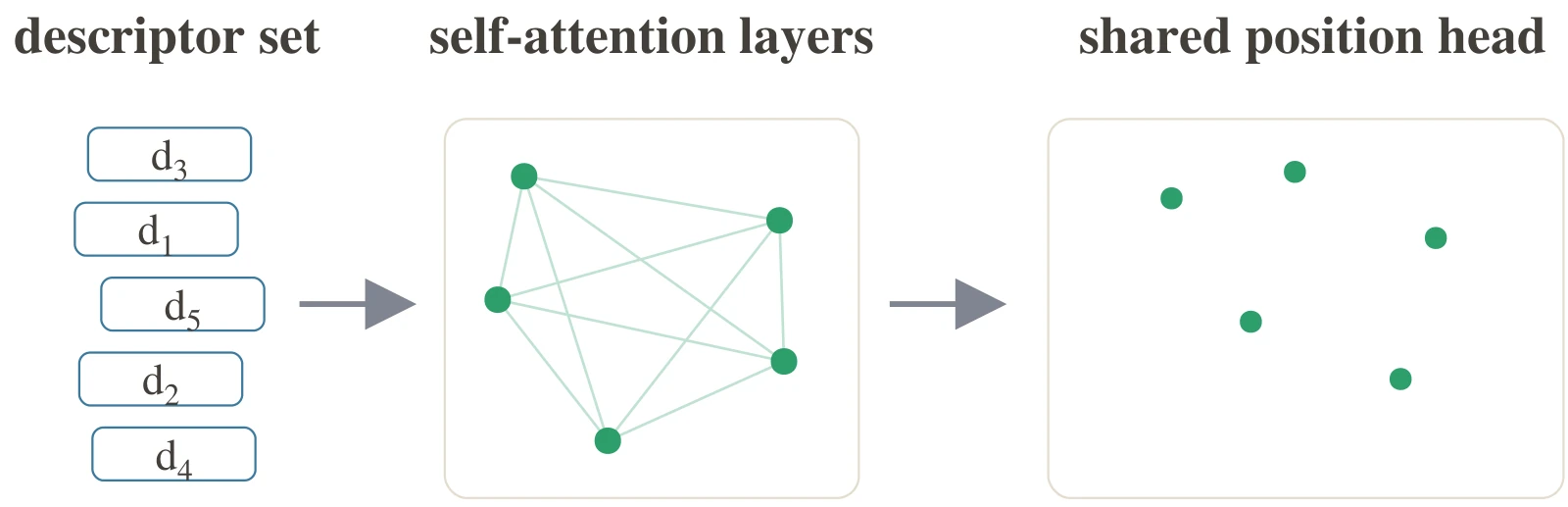
Descriptor set, self-attention layers, shared position head.
From unordered descriptors to keypoint positions. Each descriptor becomes a token, without positional encoding. Global self-attention combines the tokens; a shared head predicts one 2D position per descriptor in one forward pass.

Results

We recover keypoint positions for five learned feature extractors, and the trained solvers also work on image domains unseen during training.
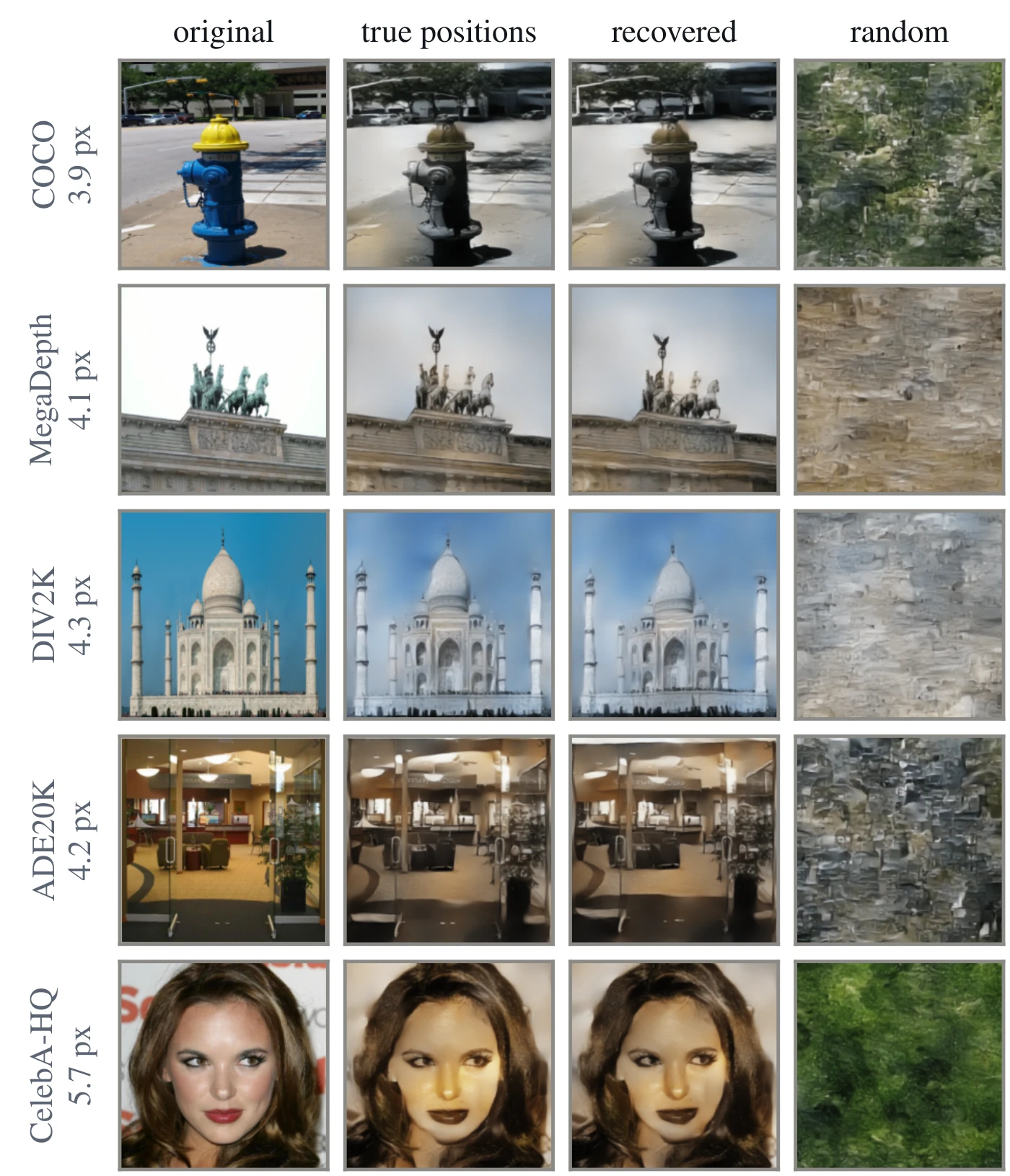
Original images and reconstructions from true, recovered and random positions, for COCO, MegaDepth, DIV2K, ADE20K and CelebA-HQ.
Recovered keypoint positions reveal recognizable image content across domains. Examples from COCO and four unseen domains (Table 1 of the paper), selected near each domain's median residual. True positions: reference reconstruction, from the GT keypoint positions. Recovered: reconstruction using positions predicted from unordered descriptors. Random: reconstruction using the same descriptors at random positions. All three use the same U-Net inverter.

The solver also recovers the layout of document images without retraining, but recovering readable text requires greater positional accuracy.
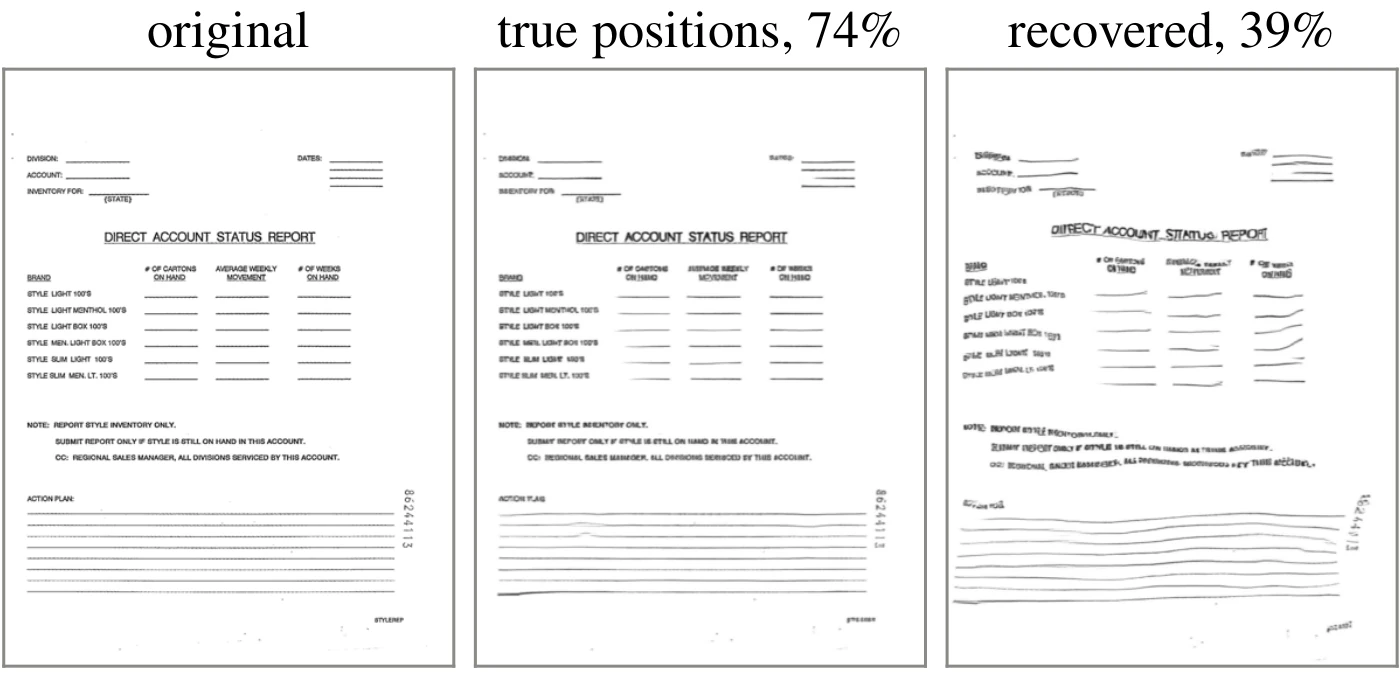
A FUNSD form and its reconstructions from true and recovered positions.
Reconstructing a document form. A FUNSD form and its reconstructions from GT and recovered positions, by a document-trained U-Net using the same descriptors. Percentages: share of the form's words read by Qwen2-VL in each image; medians over all 50 forms: 50% from GT and 15% from recovered positions (Table 4 of the paper).

Defenses

Recovery also persists in several tested settings after training on subsampled or quantized descriptors.
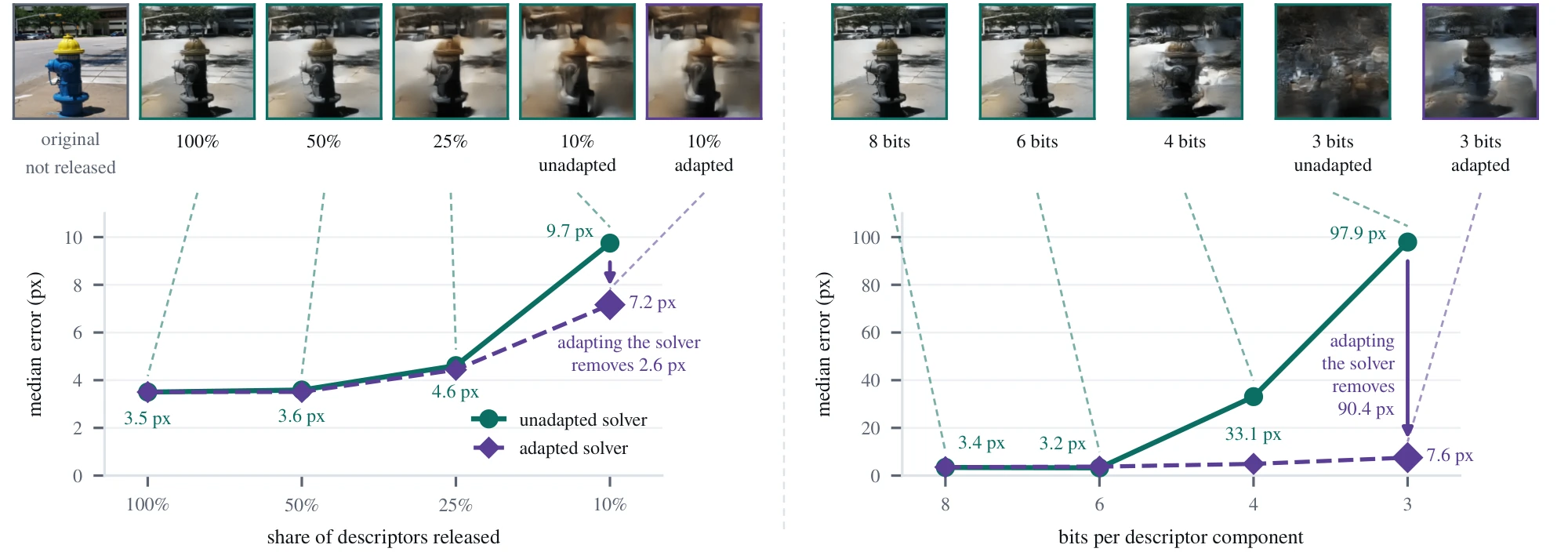
Reconstructions and layout errors for unadapted and adapted solvers under subsampling and quantization.
An adapted solver recovers layouts from sparse or quantized descriptors. Results on 200 held-out COCO images, showing median position error. Left: a random fraction of each image's descriptors is retained. Right: each descriptor component is quantized to 2b equally spaced values in [−1, 1] using b bits, then the descriptor is renormalized. Unadapted and adapted solvers receive 10 additional training epochs on unmodified and correspondingly modified descriptors, respectively. Top: U-Net reconstructions of one test image from recovered positions and the released descriptors. Bottom: layout errors for the two solvers.

BibTeX

@article{kocour2026descover,
  title   = {DescOver: Descriptor Overlap Leaks the Image},
  author  = {Kocour, Simona and Sattler, Torsten and Kukelova, Zuzana and Pollefeys, Marc and Speciale, Pablo},
  journal = {arXiv preprint arXiv:XXXX.XXXXX},
  year    = {2026}
}

Acknowledgments

This work was supported by the Czech Science Foundation (GACR) EXPRO (grant no. 23-07973X), the Ministry of Education, Youth and Sports of the Czech Republic through the e-INFRA CZ (ID:90254).